Tuesday, August 14, 2018

Pacing Yourself


They say the key to happiness, sustaining our lifestyle and managing pain is to simply pace ourselves. We have all been in a place in our lives where pacing our actions would benefit us. Whether it be because we had the flu, were pregnant, broke a leg or we were just too stressed and we needed a break!
I have heard this advice from the first day I left the doctor’s office with my diagnosis. “You have to learn to pace yourself.” My immediate thoughts were  “Yeah, I can do that, that’s easy, what else you got for me?” You can tell by my response that this concept was completely foreign to me.
I had never once been told to pace myself in any of the activities that I did. The American way is full throttle, competitive, balls to the wall, aggressive, take what is yours, work hard play hard, multitask, be a champion at everything. If you aren’t first you’re last. Hell, even my generation isn’t pacing themselves with tailgating parties. We are bingers. We need instant satisfaction. And more importantly we are creatures of total independence.
So there I was: 34 years old. Successful. Miss Independence who put herself through college and grad school by nothing less than hard work and suddenly, I was told to slow down.
My attitude: Turn down for what?
So I didn’t. Clearly the doctors, physical therapists and even those who had the same illness did not know what this fierce redhead could achieve. It’s easy… mind over matter… push push push. Those chores and grocery shopping weren’t going to do themselves. Money had to be made, traveling for work must be done, presentations had to be delivered and people had to be counseled. It was as simple as that. My life did not have any room to slow down… I didn’t even know how to pump the brakes.
And I crashed.  
My body began to rebel. My pain began to soar and my energy was non-existent. I was going through the motions because I truly believed there was no other way to live my life. It took numerous people and my persistent instincts to literally stop me in my tracks. When I crashed, I fell hard, knocking the wind out of my lungs and my legs no longer able to carry me to all of these “important” responsibilities that I had.
It was then that I realized… I was important. My health was important.  Those responsibilities would fade and someone else was capable of doing those tasks. My body needed to heal. For the past 22 months I have been trying to figure out what that four-letter word means… Pace yourself. In the last six weeks during a battle between “how to heal” and “being a workhorse” I have determined that I am the worst when it comes to pacing myself. Since I am not an expert, I thought it would be fun to de-bunk those really unrealistic expectations we place on ourselves.
1. When you feel good, take advantage of the moment and get stuff done!
Terrible advice. I still do this. Every time I have a few moments of feeling good I dive headfirst into a project that is way too big. I usually end up sitting in the middle of a mess (literally) that now I cannot even clean up because I have pushed my body to the max. Projects this month have included organizing receipts (why!?), de-cluttering my bedroom, clipping coupons (seriously?) and trying to find plans and materials to build my chicken a coop. Who am I kidding? Sometimes, it is worth paying someone a few extra bucks. Teenagers in your neighborhood are always looking for side jobs, and think of it as helping today’s youth learn responsibility!
2. Volunteer to take on extra work, because honestly you could use the distraction.
Don’t bite off more than you can chew. Nobody is going to think less of you because you didn’t jump in and take on running the PTA, hosting a book club, working on the weekend! Usually after volunteering I am set way back from where I was when I started. This certainly only works as a distraction in theory. You can enjoy all of these things but you don’t have to be the ringleader! In fact, I guarantee you will enjoy them more if you aren’t in charge!
3. Nobody wants to hear you complain, so lie about how you really feel.
Not a smart move. Being honest is not complaining, you are simply expressing the truth and your reality. “I feel really great” will result in people being excited and then they start to suggest all sorts of plans that you might not be up for. Let’s go shopping! How about a three-hour movie! Or if you have the flu, you could end up sharing your germs. I recommend being honest and sincere and those around you will do their best to understand. Sure, those with who are healthy do not know what it means to be in chronic pain but they also don’t want you to lie about something that may affect your well-being. The same with being overwhelmed or stressed out — be honest and let others know how you are feeling.
4. If someone offers you help, turn down his or her offer politely. Nobody likes a mooch.
I just learned how to ask for help at 35 years old. I laugh when I hear toddlers say “I do it myself.”  You my friend, are not a toddler anymore, declaring your independence. We all know you can do it… but… that doesn’t mean you have to do it alone. I believe people want to help you, so let them! You know that realistically you can’t do it all, so why not share some of the load? And get this… we all know people feel pretty helpless when it comes to our illness. When they are able to pick up a prescription, push your wheelchair or grab some groceries for you, it makes them feel good as well. One of my very good friends told me years ago, “Kelly, let others help you! It is a gift they are trying to give you.” Nobody wants to have their gift turned down. And if it wasn’t a sincere offering on their part, then guess what? They won’t ask you again and you can move on!
5. You feel guilty for not doing “your share” of the household chores, so even though you are feeling pretty icky, you splurge all of your week’s energy on the doing the dishes.
Another one that always gets me! If we don’t already feel bad enough, we have to addguilt in there? Why do we do this to ourselves? If your loved one really loves and understands your condition/illness, then they probably don’t expect you to mop the floors every week. They live with you and see how life affects you everyday. Would you want your significant other to feel guilty about not washing dishes? I would never! And guess what, they are just dishes. It is just cleaning. You may even create more work for the person now that you have used up your energy stash for the week. If you are having trouble with this, try heading to couples counseling where a trained professional can help you and your partner to communicate to figure out what is realistic for you. If there is extra cash, hire a housecleaner twice a month. If cash is low, check out aid services through social services, which may be free to eligible community members, or perhaps a church would be eager to help.
The bottom line is that this isn’t a competition, although sometimes it may feel like it. This is unlike any other race you have run before, so it takes some time to figure out where you may struggle and how your body responds to the environment. Be kind to yourself and know you are doing the best you can. Our bodies are amazing and even throughout all of our chronic pain and illness… we are still here.  
Be patient with yourself. Listen to your body and your instincts and don’t let the false beliefs become your strategy of pacing.

Wednesday, July 11, 2018

Metaphors Describing Fibro

1. “I feel like [I’m] constantly wading through mud. Like my brain is clogged up. My limbs are heavy and every little action requires a great deal of effort. My muscles are tired and shaky. It’s just like pushing through a bog all the time.”
2. “It’s like having the flu all the time combined with feeling like someone physically beat you up. All the while being expected to function normally.”
3. “The brain fog is like the episodes of Charlie Brown when the adults talk. All you hear is the muffled megaphone when people talk. It gets all mixed up and makes no sense in your brain. When you talk to people on the phone you can’t think of the right words, you get your sentences all mixed up and you don’t make sense. People stare at you and you know they have no idea of what you are talking about.”
4. “It’s like every part of your body is bruised but [the bruises] are invisible, and sometimes you wish they were visible because then people might take your pain seriously.”
5. “It’s always wondering if anyone got the tag of that truck that keeps running you over and over and over. Day in and day out.”
6. “You’re a kite being tossed about by unseen forces floating far from reality on a tether that can break at any moment.”
7. “My muscles are so weak they feel as though I’m trying to walk while waist deep in tar with several cinderblocks tied to my legs and arms.”
8. “Stay awake for three days then fill your rain boots with broken glass. While wearing your broken glass rain boots, run laps while being shot with paintballs.”
9. “It’s like someone has a voodoo doll of you they just can’t leave alone.”
10. “Imagine your iPhone is broken. Every time you recharge it, it may show a full battery but in reality it’s always sitting at 30 percent. Your phone has many functions, each requiring a different amount of power. It’s up to you how you use your battery. If you stick to small activities like texting your battery will last longer. If you watch a video or play a game then you will run out quicker. If you run out of battery your phone will switch off completely and take longer to charge. Fibro is the same. Your body has a very limited supply of energy. You have to think carefully about what you do every day so you don’t run out of battery and shut down.”
If You Think Autistic People Are Not Paying Attention... We Are

11. “[Fibromyalgia is] like wearing a lead apron after pulling an all-nighter a few days after being rear-ended.”
12. “[It’s] like my skeleton is two sizes too big for the rest of me, and each bone has been twisted in place.”
13. “It’s that feeling you get when you’ve worked out too hard at the gym, but it’s all the time and all you have to do is move to get it.”
14. “Imagine the worst pain you have ever felt. Now make it 10 times more intense and across your whole body. Now imagine that feeling never goes away because there is no cure.”
15. “[It’s] like an elephant is sitting on you – you feel like you spend the whole day trying to push it off. It’s exhausting and doesn’t work!”
16. “It’s like I am a ship anchored down and all I can feel is the weight of the anchor while also feeling severe burns, stabbing, electric shocks and like I’ve been beaten and run over [by] a bus throughout my body.”
17. “It’s like you are always on spring break – you’re tired, you’re hungover, you haven’t drunk enough water, your body hurts everywhere and you’re nauseated all the time; and you keep getting older and less able to deal with the symptoms.”
18. “It is like being on a merry-go-round. You spin around and around, dizzy, aching from holding onto the horse for so long, gut clenched painfully, headache looming, and you can’t remember the word for stop!”
19. “It’s like wearing an X-ray lead apron all the time while having the flu and a sunburn all over. Every once in a while, someone comes up and pours hot water over you, or sticks you with pins. You’re tired all the time, but when you lay down to sleep you cannot get comfortable, and you don’t sleep well (or for long). And this repeats like ‘Groundhog Day’ every day.”
20. “It’s like riding the world’s best, scariest, loopy, full of all kinds of twist and turns rollercoaster over and over again without having to actually get on it.”
21. “Having fibromyalgia is like a balance beam. If you have too much rest for your left hand, you will fall off from lack of activity. If you have too much activity in your right hand, you will fall off the other side. You have to find the balance or you will fall off, and it’s really difficult to get back up.”
22. “[It’s] like waking up with the flu every day, but it never runs its course. And you have to live with it forever, and pretend it’s not there.”

Saturday, July 7, 2018

Ways to Meditate on Depression

Depression Bible Verses

1 Peter 5:7 ESV
Casting all your anxieties on him, because he cares for you.

Psalm 143:7-8 ESV
Answer me quickly, O Lord! My spirit fails! Hide not your face from me, lest I be like those who go down to the pit. Let me hear in the morning of your steadfast love, for in you I trust. Make me know the way I should go, for to you I lift up my soul.

Philippians 4:6-7 ESV
Do not be anxious about anything, but in everything by prayer and supplication with thanksgiving let your requests be made known to God. And the peace of God, which surpasses all understanding, will guard your hearts and your minds in Christ Jesus.

Psalm 23:4 ESV
Even though I walk through the valley of the shadow of death, I will fear no evil, for you are with me; your rod and your staff, they comfort me.

Romans 8:28 ESV
And we know that for those who love God all things work together for good, for those who are called according to his purpose.
Depression in the Bible

Depression in the Bible

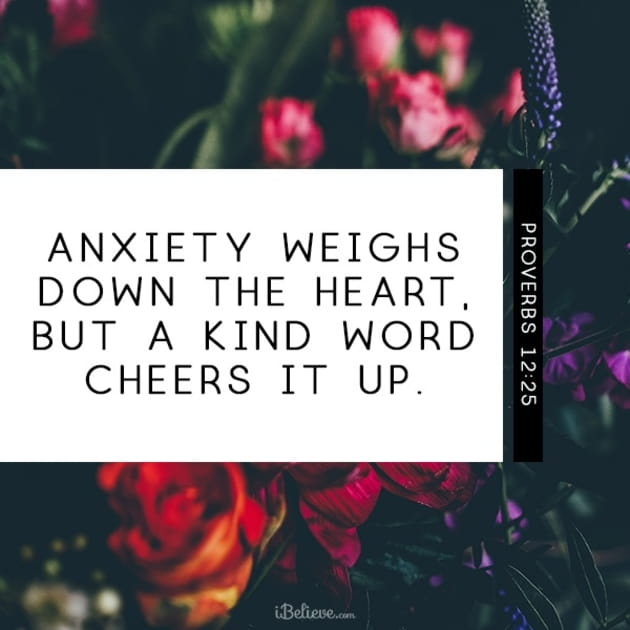
Proverbs 12:25 ESV 
Anxiety in a man's heart weighs him down, but a good word makes him glad.

Romans 12:2 ESV
Do not be conformed to this world, but be transformed by the renewal of your mind, that by testing you may discern what is the will of God, what is good and acceptable and perfect.

Psalm 9:9 ESV
The Lord is a stronghold for the oppressed, a stronghold in times of trouble.

2 Timothy 1:7 ESV
For God gave us a spirit not of fear but of power and love and self-control.

Revelation 21:4 ESV
He will wipe away every tear from their eyes, and death shall be no more, neither shall there be mourning, nor crying, nor pain anymore, for the former things have passed away.”

Bible Verses For When You're Depressed.

Bible Verses For When You're Depressed.

Psalm 34:17-18 ESV
When the righteous cry for help, the Lord hears and delivers them out of all their troubles. The Lord is near to the brokenhearted and saves the crushed in spirit.

Matthew 6:33 ESV
But seek first the kingdom of God and his righteousness, and all these things will be added to you.

Romans 15:13 ESV
May the God of hope fill you with all joy and peace in believing, so that by the power of the Holy Spirit you may abound in hope.

John 16:33 ESV
I have said these things to you, that in me you may have peace. In the world you will have tribulation. But take heart; I have overcome the world.

Joshua 1:9 ESV
Have I not commanded you? Be strong and courageous. Do not be frightened, and do not be dismayed, for the Lord your God is with you wherever you go.”

Tuesday, July 3, 2018

15 Triggers to Avoid

15 Triggers to Avoid If You Have Fibromyalgia

Tuesday, June 26, 2018

Real Causes of Fibro according to Doctors

10 Root Causes Of Fibromyalgia

1.     Gluten Intolerance

Gluten is often referred to as the “big masquerader” as it has been associated with over 55 diseases.  Its symptoms are rarely manifested as digestive issues, but rather as neurological issues like sleep disturbances, fatigue, depression, behavioral issues, cognitive impairment, and pain.

2.     Candida Overgrowth

Candida is a genus of yeasts, a small amount of which thrives in the intestines. The problem arises when it overgrows and breaks down the wall of the intestines. Consequently, it penetrates the bloodstream, releasing toxic mater within the system and causes symptoms like pain, fatigue, and brain fog.  General, most patients with fibromyalgia has had Candida overgrowth.

3.     Thyroid

Most people with thyroid-related issue are not aware they have one, and up to 90 percent of them suffer from hypothyroidism.  In order to measure the function of the thyroid gland, the doctor has to check 6 different blood markers.  When assessing and diagnosing thyroid disorders, the physician needs to focus on the optimal range instead of the standard reference range.  Getting the thyroid levels in the optimal range typically relieves fatigue, sleep disturbances, depression, and brain fog.

4.     Nutrient Deficiencies

Fibromyalgia patients are often deficient in magnesium, vitamin D, and vitamin B12.  Interestingly, many doctors claim that boosting magnesium levels has helped them reverse the patient`s condition.  The best way to measure your magnesium level is measuring the red blood cell magnesium level that can be tested in any lab.

5.     Small Intestine Bacterial Overgrowth (SIBO) and Leaky Gut

Did you know that bacteria outnumber the human cells in the body? When they get out of balance, typically as a result of antibiotics and sugar-rich diet, one can lose their ability to both digest and absorb nutrients, especially vitamin B12.  Anyone diagnosed with fibromyalgia or any similar chronic disease needs to fix the gut first, as this is a vicious cycle in which everything is closely related.

6.     Adrenal Fatigue

Chronic stress, whether real or not, is the major cause of adrenal fatigue.  Chronic pain stresses out the adrenal glands, although in most cases it`s not the initial adrenal stressor.  Vitamin deficiencies, Candida, food intolerances, and mercury toxicity are the most common adrenal stressors and it is recommended to support the adrenals with adaptogenic herbs until science comes up with the root cause and the way in which it can be fixed.

7.     Mycotoxins

Mycotoxins are toxic compounds produced by toxic mold. It is estimated that about 25 percent of the population carries the gene that makes one susceptible to the detrimental effects of mycotoxins. Unfortunately, conventional environmental mold testing doesn’t test for mycotoxins but for levels of mold spores only.

8.     Mercury Toxicity

Mercury is highly toxic to our bodies and it is considered as potential cause of fibromyalgia and other chronic diseases like neurological disorders, autoimmune diseases, chronic fatigue syndrome, and even cancer.   This is the reason why many doctors advise their patients to look for a biological dentist and get their mercury amalgam fillings removed.

9.     Glutathione Deficiency

Glutathione is an important antioxidant which plays a critical role in body`s detoxification process.  It gets recycled in the body, unless the toxic matter exceeds the normal amounts or the body lacks the enzymes required to produce and recycle glutathione.  It has been found that taking glutathione or the precursors like mill thistle and NAC helps treat fatigue.

10.  MTHFR Mutations

MTHFR is an enzyme required for methylation, an important metabolic process.  During this process both folate and folic acid are converted into active forms so that the body can utilize them.  Any MTHFR mutation makes the body less able to methylate and detoxify toxins like lead and mercury. The more mutations one has at this gene, the higher the requirements for folinic acic, methyl-B6 and methyl-B12 in order to maintain the detoxification process running normally.

Fibro

Yet, chronic pain and chronic illnesses are often invisible. In many cases there are no casts, visible rashes or runny nose involved.
Chronic pain sufferers often appear “normal,” perhaps only a bit more fragile or sad than average.
I suffered from chronic headaches for four-and-a-half years and from chronic hip pain for two-and-a-half years.
Often I looked depressed, uninterested and angry, when I was simply in pain.
There were many days I couldn’t get out of bed. Following a conversation became difficult at times.
I lost a job due to my pain. I canceled plans and ignored friends.
I felt misunderstood and alone. I was suffering. I know the answer was out there and eventually I healed myself.

Yet at the time I wanted to scream from the top of my lungs all the things all chronic pain sufferers want you to know:

1. Just because you can’t see it, it doesn’t mean I am not in pain.
2. It’s not all in my head.
3. It is not just the flu. It won’t just go away in a week.
4. Please, don’t ever say, “Just don’t think about it.” Being in constant pain this is impossible.
5. Hugs can do magic. So are nice messages. I need to know you are here for me.
6. Thank you for sharing the “magical cure” that you’ve read about online. Trust me, I’ve heard about it, and if it was any relevant, I have tried it.
7. I am trying extremely hard to live a normal life.
8. I try my darn best not to cancel plans and I would never cancel plans, if I had a choice.
9. I can’t just snap out of it.
10. Some days are better, some days are worse. Some days I may even feel close to normal, other days I can’t even get out of bed.
11. I do care about you. I want to know about your life and dreams. I want you to be happy and healthy.
12. My chronic pain is different from the other people’s chronic pain. All illnesses and pain symptoms are unique. Our experiences may differ, but we are all in pain and can relate to one another.
13. Please, don’t try to convince me to have drink and to “live a little.” All I want is to live a little—actually, to live a lot. A drink, however, is the last thing on my mind.
14. If I look all depressed or bored, it means I am actually in tremendous pain and trying my best to appear to be happy and normal.
15. I can’t really explain how chronic pain feels. Yet, I can’t say, “You will know once you have it” because I would never ever want anyone to feel so much suffering.
16. I need a lot of sleep. But sleeping can be difficult with so much pain and often still leaves me exhausted.
17. Just because I have chronic pain it doesn’t mean that I know how to manage it or to live with it.
18. Sometimes it feels like I am in a prison, living someone else’s life.
19. I still have interests, passions, goals and dreams.
20. I don’t want you to forget about me. I don’t want you to give up on me.
21. I haven’t given up on healing yet. Deep inside I know there is (or will be) an answer out there.

Sunday, June 17, 2018

CFS

. It’s not about being tired.
Yes, I’m tired. However, someone with CFS can be so fatigued it can feel like you have run a marathon with the flu. And that’s on a good day. It’s a type of tiredness that is beyond what you could start to articulate. This complex disease can affect all parts of your life and many bodily systems. A cognitive brain fog clouds your thinking, nausea doubles you over day in and day out, joint and muscle pain throbs and burns and you can’t move, the constant flu-like state, the dizziness when you try to stand and the respiratory distress from when your body is so exhausted that the simple task of breathing becomes a labored affair.
Unfortunately, it’s not a case of getting more sleep. I could have a lovely 12 hours of sleep at night and wake up feeling like I have been hit by a truck. Or I could be kept awake by pain or insomnia all night and function no differently the next day. Sometimes I wish I was simply tired.
2. What you see is not what it appears to be.
CFS is an invisible illness. Looking good doesn’t equal feeling good. I often wish people would see past the well-presented, mostly articulate and smiling woman in front of them. Even close family and friends haven’t seen the full extent of this disease on my life, especially when my symptoms flare in full force. You won’t see me out of the house when this is the case.
If, however, I have enough energy to go out on a certain day, I will factor in the energy required for everything from dressing well to putting makeup on to cover the bags under my eyes.
What you won’t see is the five minutes I sat on the floor of the shower when standing in the heat got too much. The three times I had to lay down to rest before leaving the house. The pain throbbing through my body as I moved, and the headache pounding right behind my eyes as I tried to keep up with the conversation around me. You won’t see the rest of the afternoon I spent in bed after being out of the house for just an hour.
3. The battle takes place every day.
With a fatigue-based disease such as CFS, a person only has a certain pool of cognitive, physical and emotional energy that can be accessed each day. Most days, I hope this energy reservoir will extend to having a shower, dressing and eating. But some days it won’t. I have long since outsourced my shopping, cleaning, washing and the majority of my cooking. Some days I run out of energy to eat. Other days I can get out and have a coffee with a friend. Then there is the countless medical appointments that need to be endured.
It’s about finding balance, making choices about what I will use my energy on and then dealing with the consequences if I use up too much energy. If I use too much energy, the delayed fatigue will kick in, my body will crash and I will be unable to do anything besides lying in bed for many hours or days. Unfortunately, there are unexpected curve balls, and the carefully balanced week or day gets thrown out the window. Instead, you’re left trying to make your energy ends meet while rapidly trying to steal energy for the days ahead.
4. It’s expensive.
I’m not just talking about the financial strain of medical bills, medication, supplements, specific diet and being too unwell to work. I’m talking about the huge cost on the rest of your life. It can take a toll it on your career or dreams, as others around you get the promotion you always wanted or get married while you find it difficult just to make it out of bed each day.
Then there’s the cost of not being able to care for children, spouses, family and friends. Not being able to be physically present to witness special moments in the lives of those close to you. The strain on relationships when you feel you just need to keep taking and not being able to give in return. Friendships drift apart since you have to keep turning down invites. Soon, they stop asking altogether.
Lastly, there’s the cost on your self-esteem, as the once fit and healthy body gains weight, reacts to medication and may only be able to walk as far as the mailbox each day.
5. You can’t do it alone.
You can’t survive chronic fatigue syndrome alone. It’s lonely, it’s isolating and it’s a battle each and every day. People don’t buy you flowers when you have a chronic illness, and people can get sick of hearing about a disease that continues to affect your life day in and day out. You need people on your side. People who are willing to be in there for the long haul. You need supportive friends and family who are happy doing your washing, who will still drop meals off three years into your illness, who give you lifts and sit on the couch eating tasteless, cheeseless gluten-free pizza with you. You need text messages and prayers. You need friends reminding you of your hope. You need people who look past your “I’m fine” responses and see the truth. You need medical professionals who are willing to fight alongside you, never doubting the disease and it’s huge impact on your life.